
5 Trends Shaping Digital B2B Sales
Learn the 5 trends shaping digital B2B sales, from video and AI to RevOps and mental health.





The COVID-19 pandemic forced B2B buyers & sellers to embrace digital in a massive way. What started out as a crisis response has now become the new normal, with big implications for the future of buyer & seller interaction.
The Future of Sales is the permanent transformation of organizations’ sales strategies, processes and allocation of resources, moving from a seller-centric to a buyer-centric orientation and moving from analog sales processes to hyper-automated, digital-first engagement with customers.
"The Future of Sales in 2025: A Gartner Trend Insight Report"
Digital sales is the new normal
The strategy of digital sales has been applied for many years in the world's leading B2B SaaS companies, but the COVID pandemic accelerated the adoption across all industries, making digital sales the new normal.
A recent Bain & Company survey (conducted with Dynata) found that 92% of B2B buyers prefer virtual interactions, up 17 percentage points from last years' survey in May 2020. More sellers also realize its effectiveness, now at 79% compared with 54% last May. With buyers preferring virtual interactions, digital sales has become the new normal.
While there are many key benefits to the digital sales model such as saving time traveling, cost-effective interactions, and the ability to interact with more prospects, digital sales falls short on effectiveness and efficiency at many companies. Employers are adopting the latest technologies to make the digital sales workforce successful.
Below the 5 trends in a digital sales world:
1) Video & live chat are the channels to close deals
A report by McKinsey has shown that video and live chat have emerged as the dominant channels for interacting and closing sales with B2B prospects, while in-person meetings and related sales activities have dropped precipitously.
Video conferences usage is up 46% at 53%, and online chat usage is up 23% at 49%. Compared to in-person meetings, video and chat enable measurement and analytics to learn what works to close deals.
2) Automation, AI, analytics will touch every buyer interaction.
The buyer journey starts long before a sale actually happens. Buyers research solutions online, interact via video & online chat, and collaborate with vendors to make the right decisions. The opportunity: every touchpoint will be measured. Every part of the sales process will be highly technology-enabled driving efficiency and effectiveness for revenue teams.
- Automation and workflow tools will reduce repetitive tasks, optimize workflows for efficiency and effectiveness.
- Data analytics & intelligence tools will track, measure and attribute every touchpoint, helping to make sense of what actually works in sales.
- Data insights tools will help clean CRM data laying a foundation for everyone to work on the right things.
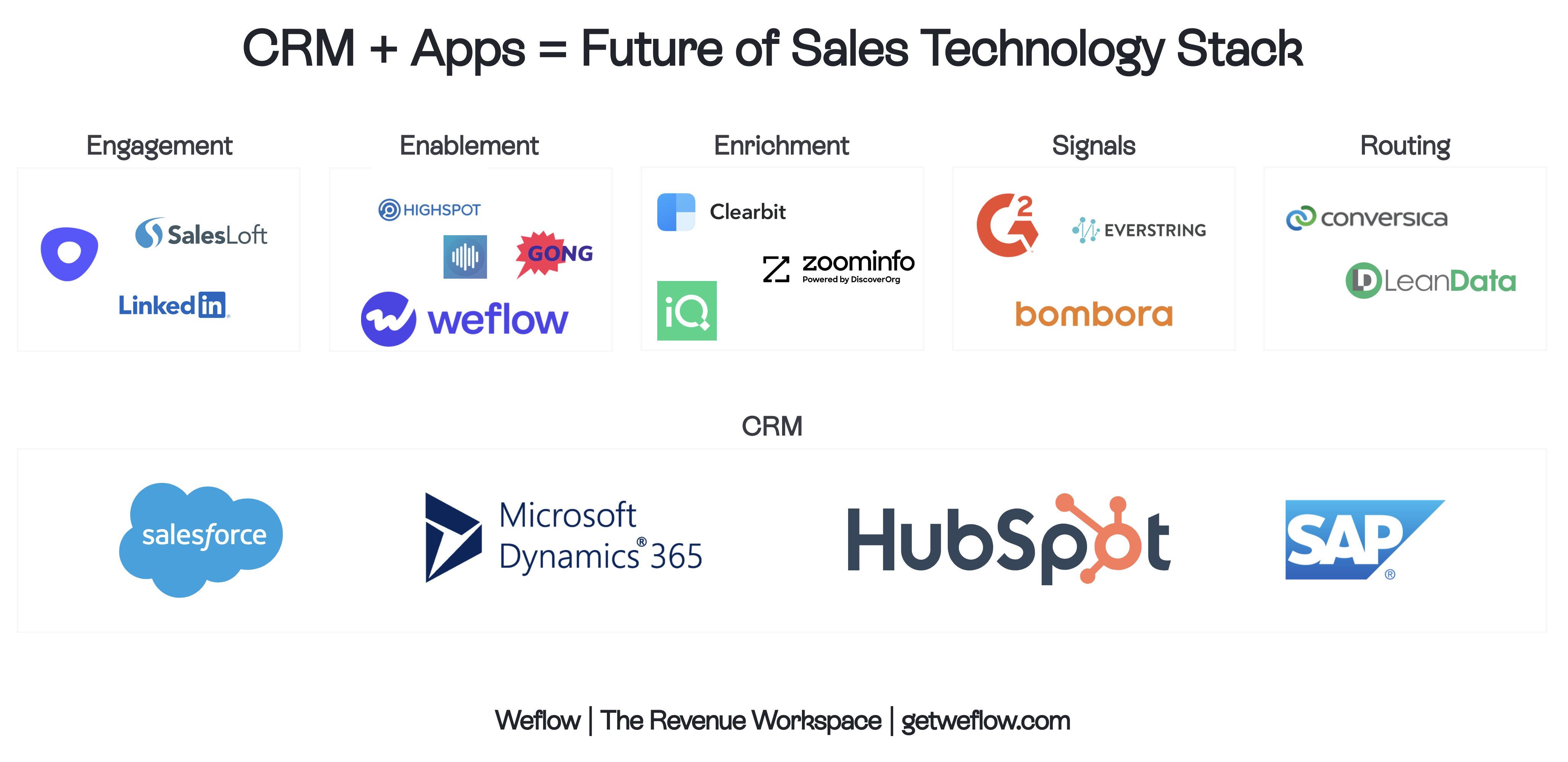
3) CRM + Apps = The Future of Sales Tech Stack
CRMs will remain the system of record for customer data, but workflow automation, insight, and analytics applications will build on top of CRMs to drive efficiency gains, and make sales teams more effective. Innovation is driven by apps sitting on top of CRMs.
Sales professionals will spend a lot more time in workflow automation apps than the original CRM. Some powerful sales apps will become lightweight CRMs that may chip away market share for bigger more enterprise-focused CRMs.
4) New roles, new orgs, new processes
VP will become Chief Revenue Officers, CROs will become Chief Operating Officers to manage the revenue generation process end-to-end. COOs are the new CROs. Specialized roles will help sales leadership to make the individuals more productive and use data to arrive at insights for product, marketing, and overall go-to-market.
RevOps will be a key to establish efficient and effective sales processes.
Sales Enablement & Product Marketing drives consistency, coaching and performance.
Sales Professionals will be even more consultative, value-driven, technical and quantitive.
5) Mental health matters
According to studies of the WHO, mental health cost to the global economy is US$ 1 trillion in lost productivity.
Sales is a hyper demanding profession. A study by the Sales Health Alliance found that 50% of sales professionals report micro-management by leadership as the #1 negative impact on mental health, only followed by missing targets with 40.6% missing targets. Other reasons include working in demotivated teams, meeting daily metrics, stale pipeline, cold calling, comp or role changes, and buyer/ customer ghosting.
For digital sales to work, you need to find sales software that empowers your team within the processes you plan to set up. Modern sales software should be designed to make sales leadership, sales enablement, and sales professionals more productive and effective.
We designed Weflow with revenue teams in mind to reduce admin work, finding information, and repetitive tasks. We set out to free teams from too many tabs open, too many copy-pasting, too much time spend searching information across Salesforce, Slack, notepads, so everyone can spend time closing deals.
With Weflow, revenue teams are able to manage their pipeline, notes, tasks, and meeting in one place. Keep track of the metrics that matter, increase their win rate, develop deeper customer relationships, and provide the tools to streamline the process.
Want to know more? Shoot us an email or sign up for our early access program.

.webp)