
Territory Design Agent
Propose territory splits based on account potential and the capacity each rep actually has, while keeping existing relationships where possible and showing the cost of every ownership change.
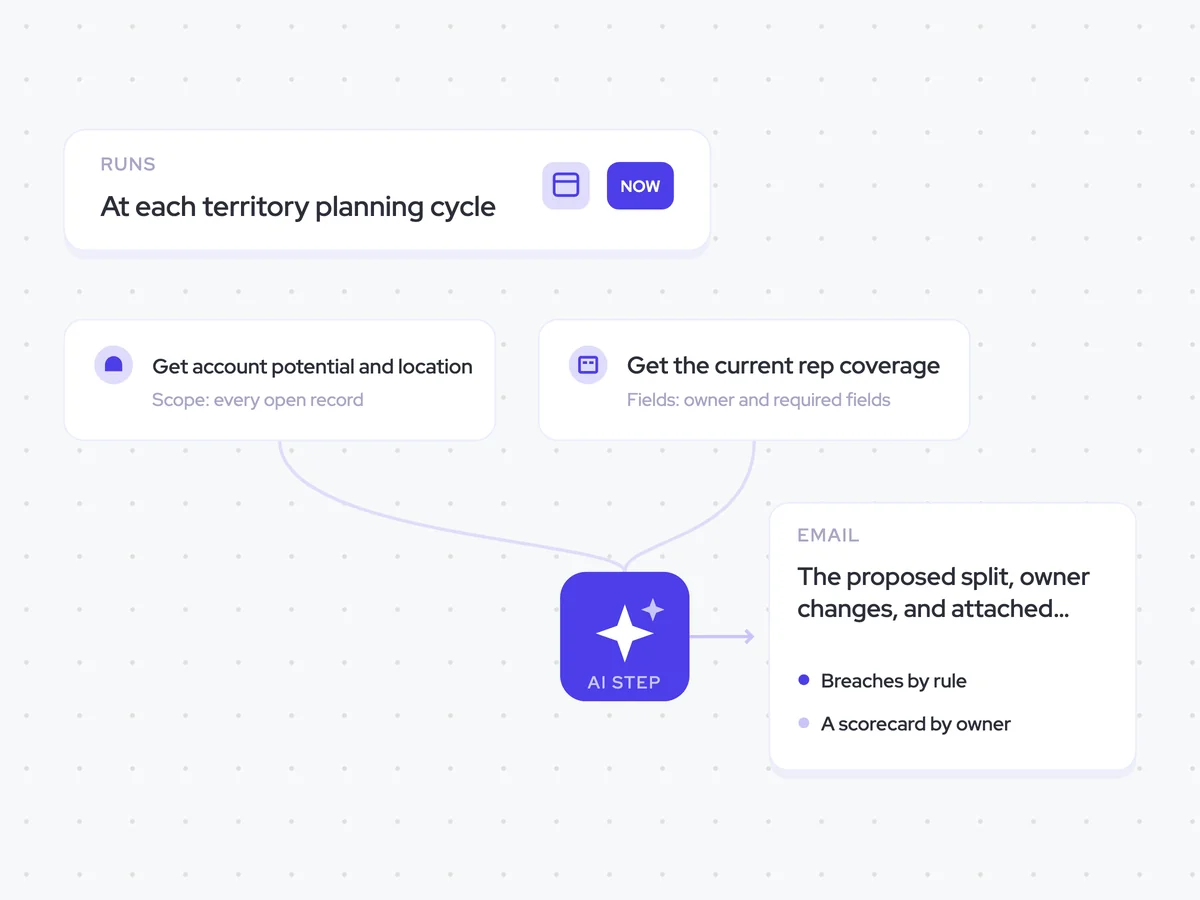
- Trigger: at each territory planning cycle
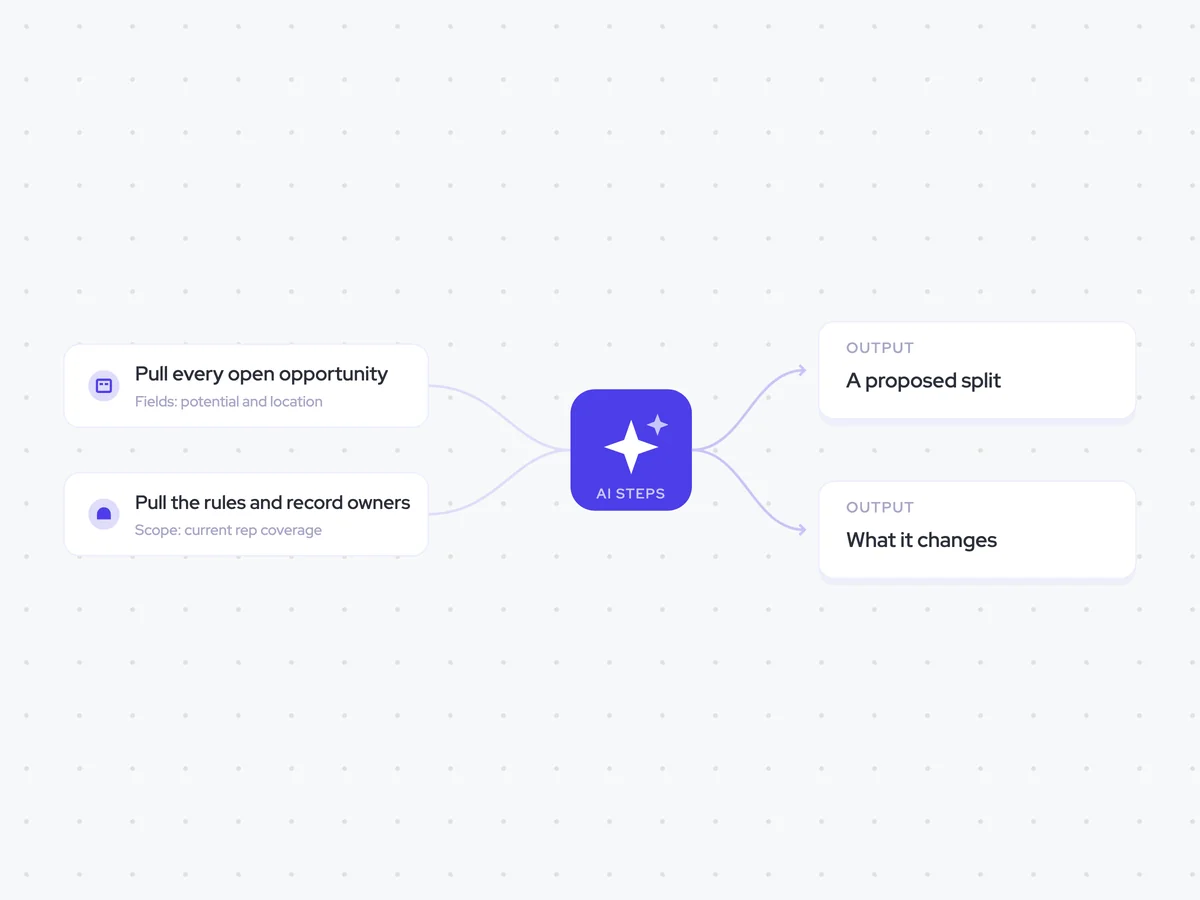
- AI steps: propose the territory split, then list what moves
- Output: the proposed split, owner changes, and attached revenue sent to leadership and RevOps
Agent breakdown
A blueprint to adapt, not a fixed recipe. Set the trigger, thresholds, and methodology that fit your team, and each step builds on the last, using the conversation and CRM context you already capture.
Run at each territory planning cycle
At each territory planning cycle, the agent starts a new territory proposal. Keeping the redraw to a planned cycle avoids changing ownership mid-quarter, when the disruption can cost more than the new split fixes.
- Schedule: At each territory planning cycle
- Runs mid-quarter: Never
Get account potential and location
The agent pulls the potential and location of each account in scope. These are the two main constraints it uses to decide how much opportunity belongs in each territory and where the boundaries should sit.
- Object: Account
- Fields: Account potential and location
Get the current rep coverage
Next, the agent pulls the current rep coverage to see who owns what today. This gives it the existing relationships and current workload to account for, rather than proposing a clean map that nobody will adopt.
- Object: Opportunity
- Scope: Current rep coverage
- Include: Who owns each account today
Propose the territory split
Using the account data and current coverage, the agent proposes territories balanced on potential and the capacity each rep actually has. It keeps existing relationships where it can, so the proposal improves the split without moving accounts unnecessarily.
You are proposing a territory split for the next planning cycle.
Input: each account's potential and location, plus current rep coverage and ownership.
- Balance the territories on account potential and the capacity each rep actually has.
- Use account location when deciding where each territory should sit.
- Keep each account with its current owner where you can.
- Do not balance potential by ignoring current rep capacity or existing relationships.
Return the proposed territory split, listing each account's current owner, proposed owner, location, and potential. Show the total potential in each territory and which existing relationships are kept.
List what changes
The agent compares the proposed split with current coverage and lists every account that would change owner. It includes the revenue attached to those accounts, so leadership and RevOps can see the real cost of the redraw alongside the new territory map.
Compare the proposed territory split with current rep coverage.
Input: the proposed split, current account ownership, and the revenue attached to each account.
- List every account whose owner changes under the proposed split.
- Name the current owner and the proposed owner for each account.
- State the revenue attached to each account that moves.
- Add the total revenue attached to all ownership changes.
Rules: include only accounts changing owner. Do not count accounts that stay with their current owner.
Return the list of accounts changing owner and the revenue attached, followed by the total revenue affected by the redraw.
Send the proposal to leadership and RevOps
Finally, the agent emails the proposed territory split to leadership and RevOps, together with the accounts changing owner and the revenue attached. Both groups receive the map and the disruption priced, rather than reviewing the new boundaries without seeing what they would move.
- Recipients: Leadership and RevOps
- Include: The proposed territory split, accounts changing owner, and revenue attached
- Sends externally: Never
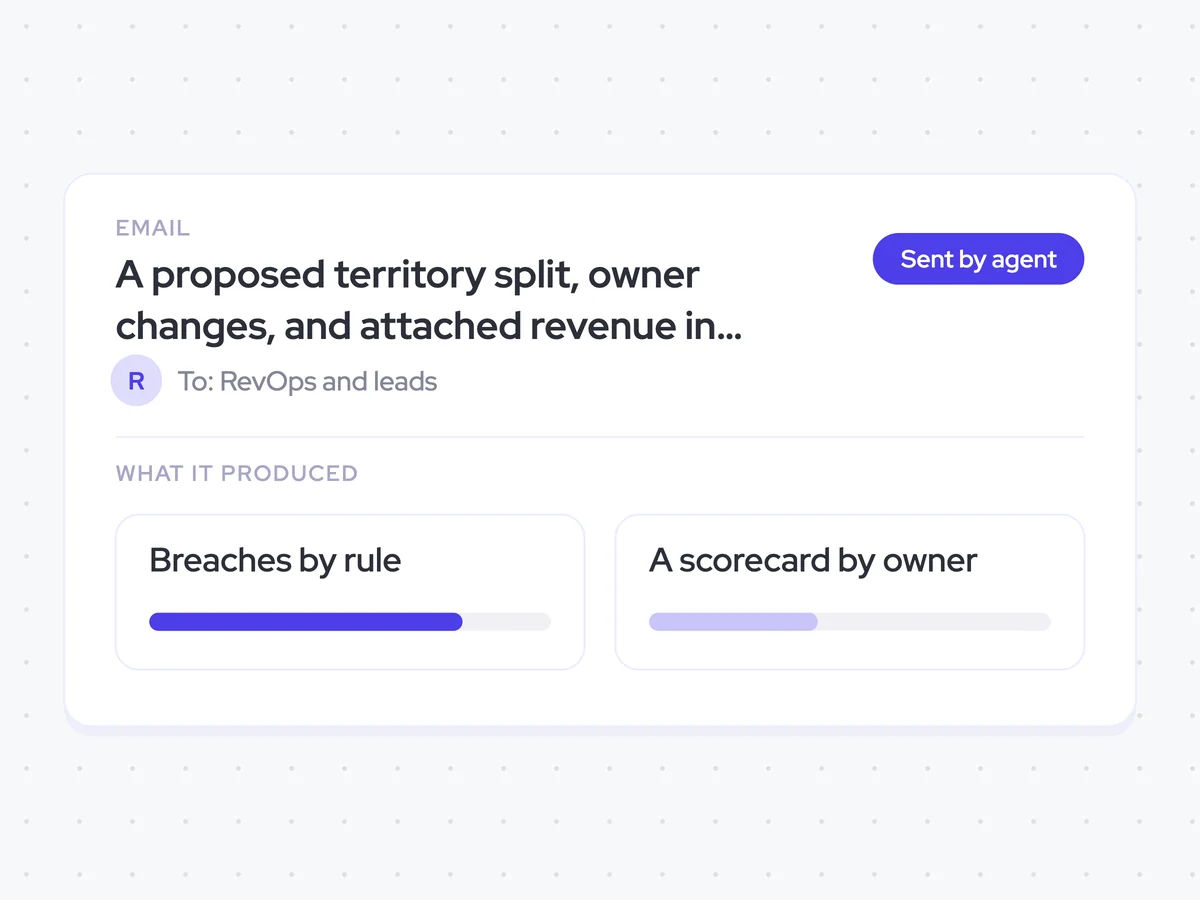
A proposed territory split, owner changes, and attached revenue in leadership and RevOps inboxes
See how the proposed territories balance account potential with the capacity each rep actually has, while keeping existing relationships where possible. The proposal also lists every account changing owner and the revenue attached, so you can weigh the new split against the disruption it creates.
AI Agents that pair well
Same data, different jobs. Run them together for a fuller picture.

Learn more about GTM & Revenue Operations
RevOps Lab Podcast


50+ Free GTM & RevOps Cheat Sheets

Free RevOps Community (1k+ members)
.webp)