
MEDDPICC Scoring Agent
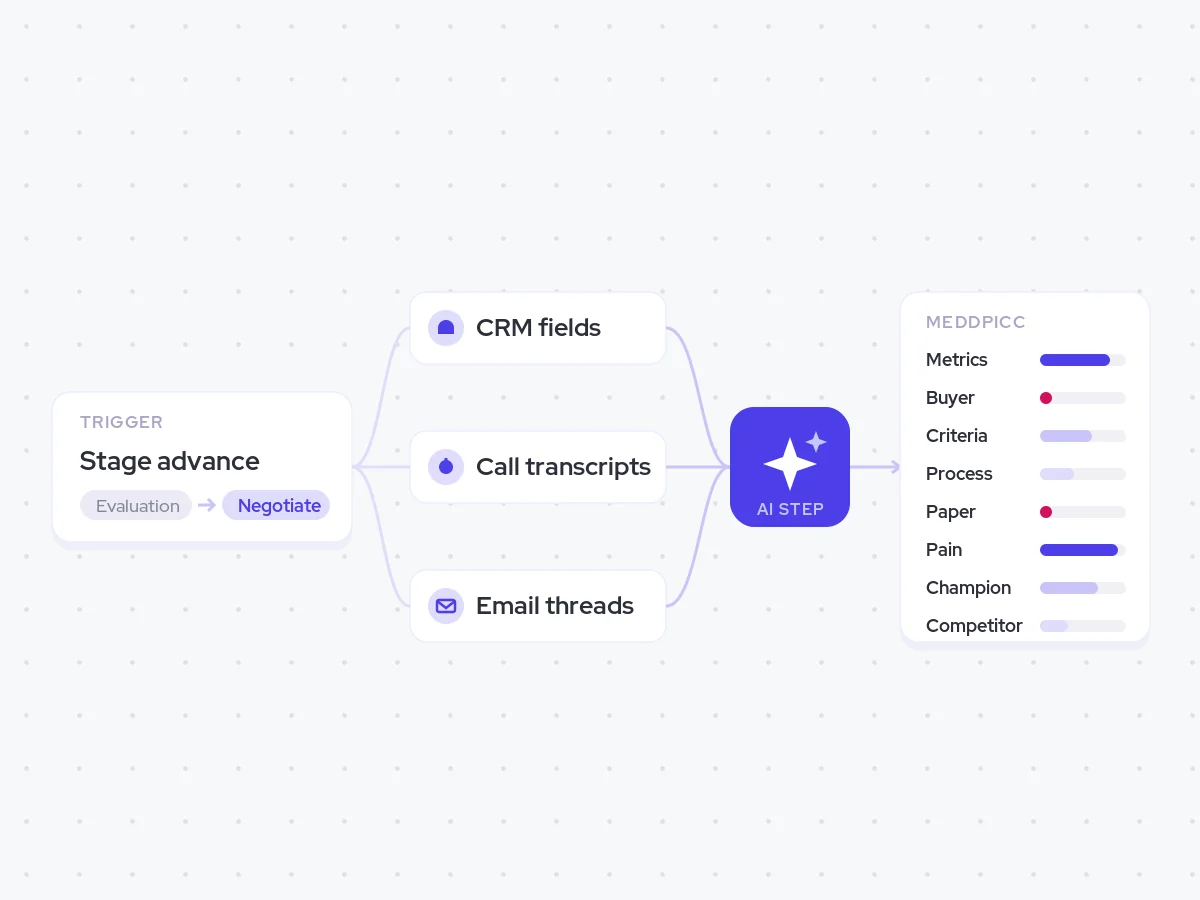
Score each open deal against MEDDPICC using evidence from buyer conversations, and flag the elements with weak or missing evidence.
Trigger: a deal advances to a new stage
AI steps: score each element, then find the gaps
Output: scores, evidence, and gaps written to the opportunity
Agent breakdown
A blueprint to adapt, not a fixed recipe. Set the trigger, thresholds, and methodology that fit your team, and each step builds on the last, using the conversation and CRM context you already capture.
Run when a deal advances to a new stage
Whenever an open opportunity advances to a new stage, the agent runs the assessment again. Qualification evidence changes as the deal progresses, so this keeps the MEDDPICC scores current as the buyer shares more information.
Trigger: An opportunity advances to a new stage
Include: Open opportunities
Get the deal's MEDDPICC fields
Next, the agent pulls the MEDDPICC fields previously filled in by the rep. It will compare each entry with evidence from the deal's call transcripts, rather than treating the CRM entry itself as evidence.
Fields: The rep's current entries for all eight MEDDPICC elements
Include: MEDDPICC fields as currently filled in on the opportunity
Gather the deal's call history
The agent then pulls the calls and transcripts linked to the deal. These give it the buyer's own words to use when checking the rep's entries and scoring each MEDDPICC element.
Calls: All calls linked to the opportunity
Transcripts: The available transcripts for those calls
Score each MEDDPICC element
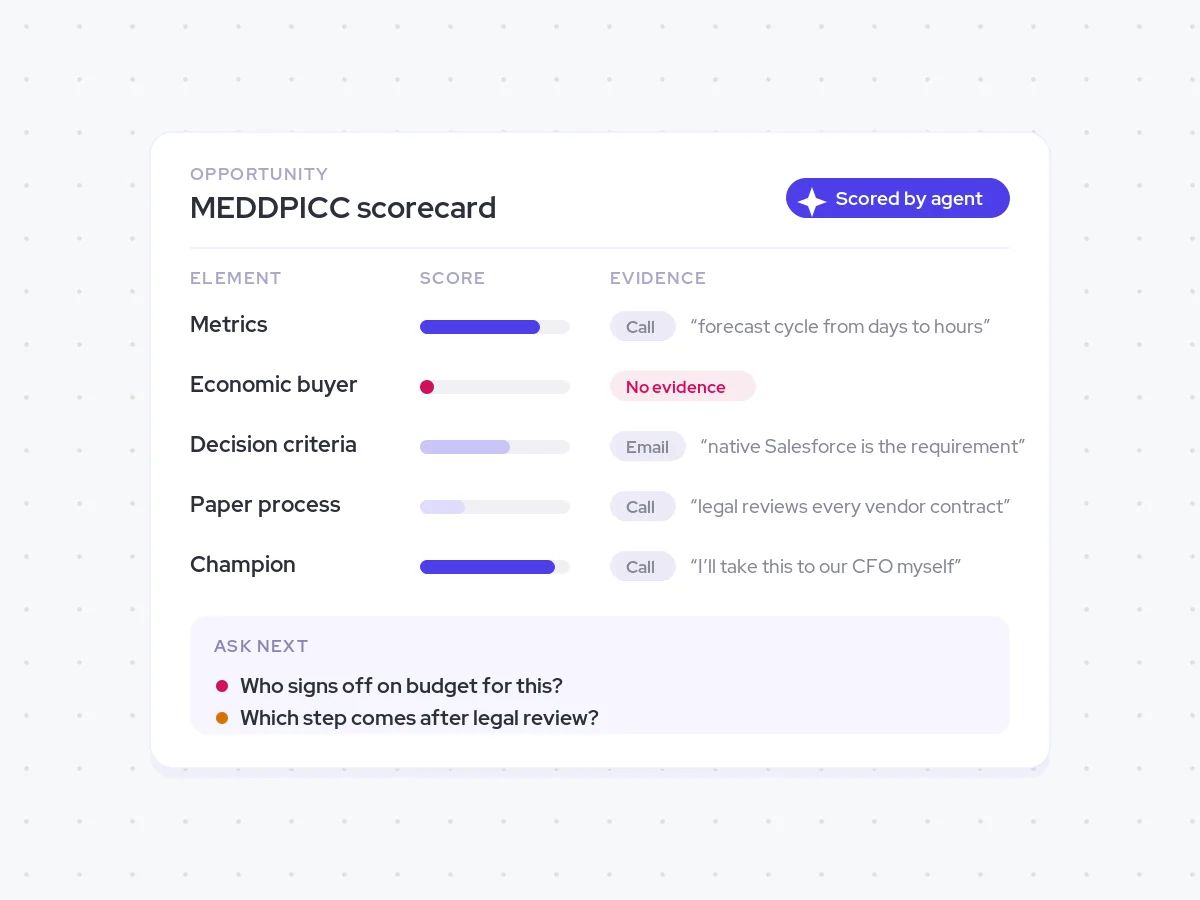
For each MEDDPICC element, the agent compares the rep's entry with what the buyer said and assigns a score from 0 to 5. It returns the evidence supporting each score, so reps and managers can see what the assessment is based on.
If no buyer evidence supports an element, the agent scores it 0 and says that no evidence was found.
You are scoring an open opportunity against MEDDPICC.
Input: the rep's current MEDDPICC entries and the call transcripts linked to the opportunity.
For each element, Metrics, Economic buyer, Decision criteria, Decision process, Paper process, Identified pain, Champion, and Competition:
Compare the rep's entry with what the buyer said in the call transcripts.
Score the element from 0 to 5.
Return the buyer evidence that supports the score.
State whether the rep's entry is supported by the buyer evidence.
Rules: use only statements from buyers as scoring evidence. Do not treat the rep's MEDDPICC entry as evidence. If no buyer evidence supports an element, score it 0 and say that no evidence was found. Do not infer details that the buyer did not state.
Return a table with the columns: element, score, supporting evidence, rep entry, supported by evidence (yes/no).
Find what's still missing
Using the scores and evidence, the agent identifies the MEDDPICC elements with weak or missing evidence. For each gap, it writes the question the rep should ask next to get the missing information from the buyer.
Review the MEDDPICC scores and supporting evidence from the previous step.
Identify every element with weak or missing buyer evidence.
Explain what evidence is still missing.
Write one clear question the rep should ask next to get that information from the buyer.
Rules: base the gaps only on the scores and buyer evidence from the previous step. Do not infer missing details. Write one question per element and do not combine multiple questions.
Return a list with the element, the missing evidence, and the question the rep should ask next.
Save the latest assessment to the opportunity
Finally, the agent writes the latest MEDDPICC assessment back to the opportunity. Reps and managers can see the scores, supporting evidence, and questions alongside the deal as it moves forward.
Update: MEDDPICC scores, supporting evidence, and gaps
Include: The questions the rep should ask next
Destination: The opportunity
MEDDPICC scores, supporting evidence, and next-call questions on the opportunity
See how each open deal scores across the eight MEDDPICC elements, what the buyer has confirmed, and what the rep still needs to ask. The latest assessment sits on the opportunity, with supporting evidence and a next question for each weak or missing element.
For reps: Review the gaps before the next buyer call and use the questions to guide the conversation.
For managers: Check the latest scores and evidence as the deal progresses.
AI Agents that pair well
Same data, different jobs. Run them together for a fuller picture.

Learn more about GTM & Revenue Operations
RevOps Lab Podcast


50+ Free GTM & RevOps Cheat Sheets

Free RevOps Community (1k+ members)
.webp)