
Job Change Agent
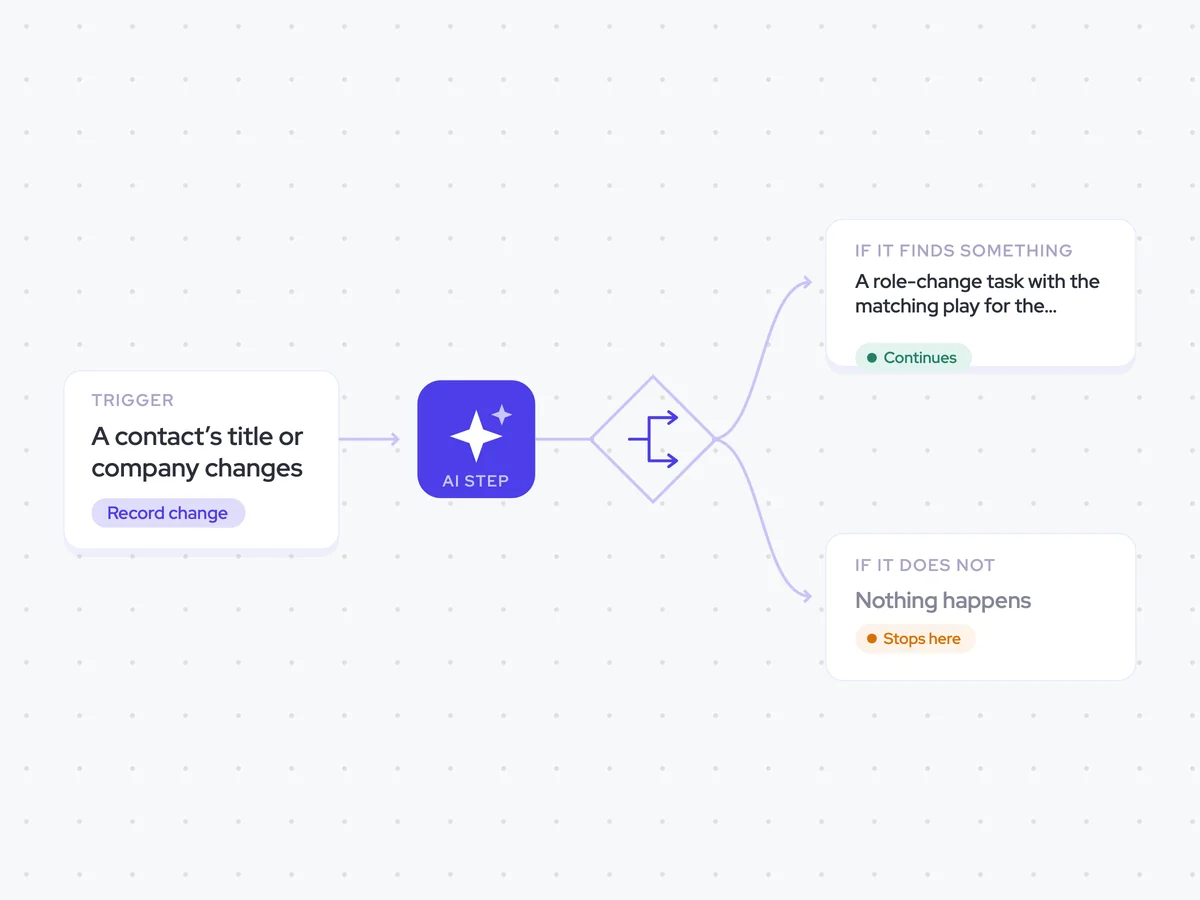
Spot when a contact changes role, decide whether the move puts an existing customer or deal at risk or creates a way into a prospect, and give the account owner the matching play.
- Trigger: a contact’s title or company changes
- AI steps: decide whether the role change is a risk or an opportunity
- Output: a task for the account owner carrying the matching play
Agent breakdown
A blueprint to adapt, not a fixed recipe. Set the trigger, thresholds, and methodology that fit your team, and each step builds on the last, using the conversation and CRM context you already capture.
Run when a contact changes role
When a contact’s title or company changes, the agent starts the workflow. This catches moves inside the same business as well as contacts leaving for another company.
- Trigger: A contact’s title or company changes
- Include: Moves within the business and departures from it
Check whether they are linked to a customer or deal
Next, the agent checks whether the contact is linked to a customer, an existing deal, or a prospect. That context matters because a champion leaving a customer or deal is a risk, while someone arriving at a prospect can provide a way in.
- Fields: Customer or prospect status
- Check: Whether the contact is linked to an existing deal
Decide whether the change is a risk or an opportunity
Using the account and deal context, the agent decides whether the role change is a risk or an opportunity and explains why. It treats a departure from a live customer as a risk and an arrival at an account with no open deal as an opportunity.
Decide whether this contact’s role change is a risk or an opportunity.
Input: the contact’s title or company change, whether the account is a customer or prospect, and whether it has an open deal.
- Classify a departure from a live customer as a risk.
- Classify an arrival at an account with no open deal as an opportunity.
- Explain which account and deal context supports the decision.
Return the classification, risk or opportunity, followed by a short explanation.
Route the change to the matching play
Based on that decision, the agent routes the change to the matching play. The account owner gets a retention move for a customer or deal risk, or an outreach move when the contact creates a way into a prospect.
- Risk branch: If linked to a customer or deal, route as a risk with a retention play
- Opportunity branch: If linked to a prospect, route as a way in with an outreach play
Create a task for the account owner
Finally, the agent creates one task for whoever owns the account today. The task carries the recommended retention or outreach play, not just a notification that the contact moved.
- Assigned to: The current account owner
- Task content: The role change and the recommended play
A role-change task with the matching play for the account owner
Get one task when a contact’s role changes, assigned to whoever owns the account today. The task explains whether the move is a risk or an opportunity and carries the matching retention or outreach play, so the rep knows what to do next.
- For reps: Follow the recommended play to protect the existing customer or deal, or use the contact’s move as a way into the prospect.

AI Agents that pair well
Same data, different jobs. Run them together for a fuller picture.

Learn more about GTM & Revenue Operations
RevOps Lab Podcast


50+ Free GTM & RevOps Cheat Sheets

Free RevOps Community (1k+ members)
.webp)