.webp)


Free Customer Success Operations Cheat Sheet
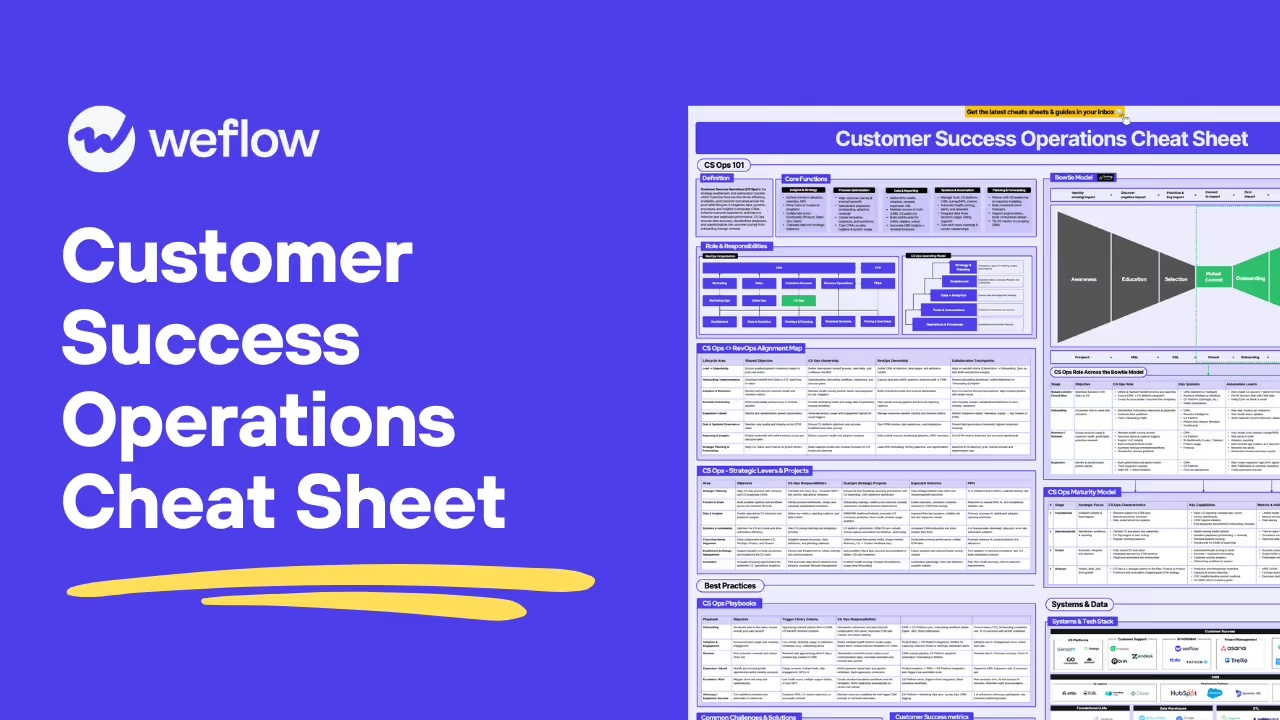
This cheat sheet gives you the CS Ops blueprint. It covers 7 areas:
- CS Ops 101
- CS Ops Playbooks
- CS Ops Automations
- CS Ops Best Practices
- CS Ops Role & Responsibilities
- CS Ops Systems, Tech, and Data
- CS Ops Challenges, Solutions & Metrics

"With Weflow, we’re now capturing all relevant activities and have full transparency into the performance of each sales rep. It’s a game changer."

.svg)
%201.svg)
"Weflow gives us better visibility and predictability of our business."




"Weflow eliminated the need for our VP to ask, ‘Did you follow up with that deal?’. It tracks customer interactions automatically, creating a framework that drives accountability across the team."



"None of the other tools gave us a solution like Weflow. From the beginning, we had a really smooth process."
.webp)


"I had a first introductory call with Weflow. I think I was sold after 15 minutes. There’s no question that the people at Weflow understood the problems that we were trying to solve."


"I’ve worked with Gong before, but Weflow’s simplicity and real-time sync are game-changing."
.webp)



"We use Weflow to auto-capture activity data, run deal reviews, and analyze our pipeline to inform our forecast. Being able to spot deal risks early has improved win rates and pipeline health."



.svg)
.svg)


.svg)

.svg)

.svg)
What's Inside
CS Ops Operating Model
- The five pillars that define the function: strategy and planning, enablement, data and analytics, tools and automations, and operations
- Stage-by-stage CS Ops responsibilities across the bowtie from Closed-Won through onboarding, retention, renewal, and expansion
- A four-stage maturity model with concrete markers like automated health scoring, renewal forecasting, capacity planning, and NRR above 110%
RevOps Alignment Frameworks
- Ownership map showing where CS Ops owns health models and handoffs while RevOps owns CRM schema, forecast cadence, and ARR reporting
- Shared operating mechanisms including joint forecast reviews, a GTM metrics dictionary, data governance framework, and quarterly Finance and Product planning
- An org design model placing CS Ops inside RevOps under the CRO, alongside Sales Ops, Marketing Ops, and FP&A
Systems, Metrics, and Automation
- The post-sale data stack covering CRM, CS platform, product usage, billing, support, BI, ETL, and automated activity capture with governance cadences
- Benchmarked CS metrics operators can apply directly: adoption above 60%, GRR above 90%, NRR above 110%, support response under 4 hours
- Trigger-action automations like onboarding task creation at Closed-Won, At Risk tagging on health drops, and expansion opps when usage exceeds contract

Daniel Schemmert
Daniel Schemmert is the Head of Growth at Weflow, where he's built the GTM engine from scratch. He spends valuable time talking to RevOps leaders about how they run pipeline, forecasting, and Salesforce. He's also the co-founder of RevOps Chat, the Slack community where 1,000+ RevOps practitioners share what's actually working inside their revenue orgs.


Go Deeper
Customer Success Operations: Health Scores, Renewals, and Playbooks
#19 Financial metrics that drive customer success ops
RevOps Cheat Sheet
Frequently asked questions
What is CS Ops and how is it different from just being a CSM who's good at data?
CS Ops is a dedicated function that owns the systems, processes, playbooks, and reporting infrastructure that CSMs operate within — it's not a CSM wearing an extra hat. A strong CSM might pull a great report or build a one-off workflow, but CS Ops is accountable for the health scoring model, the CRM-to-CS-platform integration, the renewal forecast cadence, and the onboarding playbook that every CSM follows consistently. Without that separation, you get tribal knowledge instead of repeatable process.
Do I need a dedicated CS platform like Gainsight to apply what's in this cheat sheet, or can I work out of a CRM?
You can get through the Foundational and early Operationalized maturity stages with a CRM plus some automation tooling like Make or Zapier, but the health scoring models, alert triggers, and playbook automation described in the cheat sheet are significantly harder to run cleanly without a CS platform. The cheat sheet references Gainsight specifically for health score updates, risk alerts, and renewal task automation — those workflows exist in CRMs but require heavy custom build to match what a purpose-built CS platform handles natively. Start with what you have, but plan the migration early.
Which automations in this cheat sheet should stay human-led rather than fully automated?
The cheat sheet flags this directly: automate what's predictable and repeatable, and keep humans in the loop for nuanced or high-touch signals. Specifically, auto-creating onboarding tasks on Closed-Won, renewal reminders at 90 days, and health score updates from usage data are safe to fully automate. Escalation decisions — like when a low health score plus a support ticket spike signals real churn risk — should trigger an alert to a CSM or CS leader, not an automated customer-facing action.
What data do I need to have clean before I can build a reliable health scoring model?
At minimum you need product usage data, renewal dates, ARR, and NPS scores flowing into a single system without manual reconciliation steps. The cheat sheet's governance section calls out renewal date, ARR, and segment as the fields most commonly missing or stale in CRM — if those aren't validated and required fields, your health score will be wrong before you even define the model. Fix the data plumbing and validation rules first, then build the scoring logic on top of it.
How do I know if our CS Ops function is actually performing well, versus just being busy?
The cheat sheet gives you the answer: CS Ops needs its own KPIs, not just the metrics it tracks for the CS team. Specifically, measure data accuracy rates, automation utilization, forecast accuracy percentage, and process adoption rates across CSMs. If you can't point to a reduction in manual effort, an improvement in renewal forecast variance, or a measurable increase in tool adoption after a rollout, you're running a reporting function — not an operations function.
How often should we revisit our CS Ops playbooks once they're built?
The cheat sheet flags process drift as a direct consequence of not assigning ownership and an update cadence to each playbook. A reasonable baseline is a quarterly review for high-frequency playbooks like onboarding and renewal, and a semi-annual review for expansion and escalation. Tie the review trigger to something concrete — a change in your health score model, a shift in your ICP, or a new product line — so it's not just a calendar exercise.