.webp)


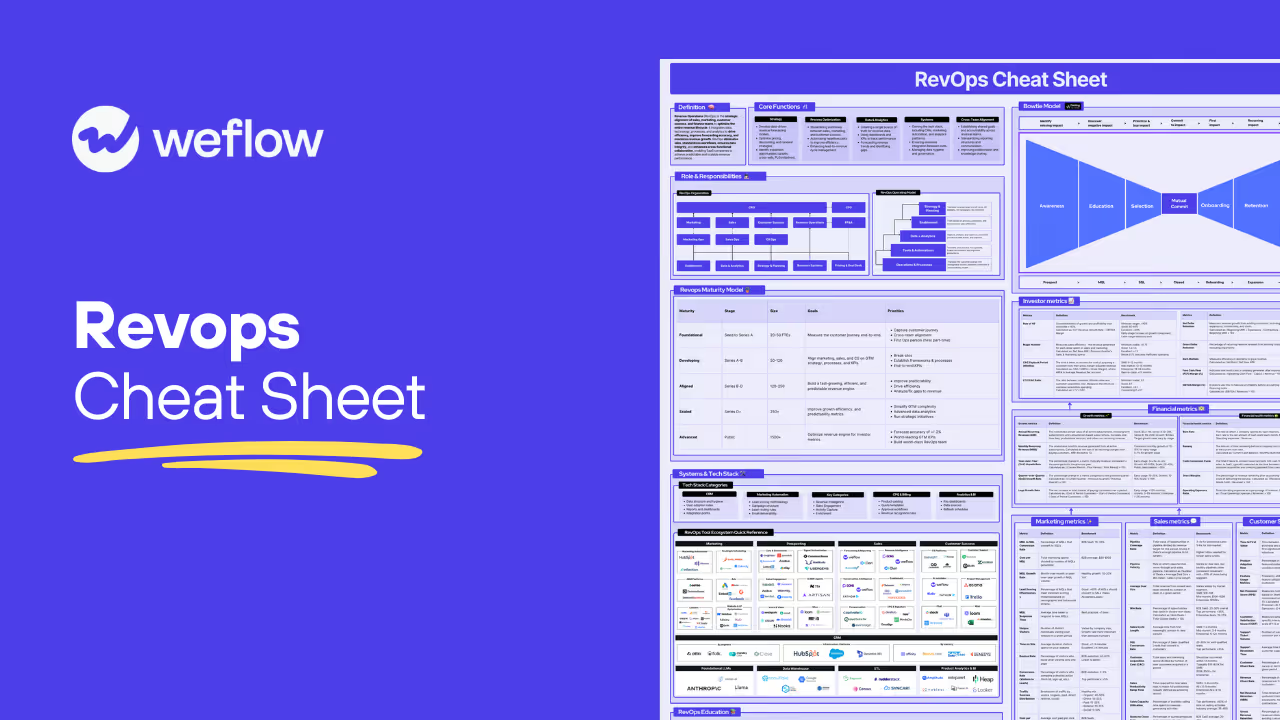
RevOps Cheat Sheet
What is RevOps? This cheat sheet outlines:
- The RevOps role in the GTM team
- RevOps frameworks & operating model
- GTM metrics & maturity model

"With Weflow, we’re now capturing all relevant activities and have full transparency into the performance of each sales rep. It’s a game changer."

.svg)
%201.svg)
"Weflow gives us better visibility and predictability of our business."




"Weflow eliminated the need for our VP to ask, ‘Did you follow up with that deal?’. It tracks customer interactions automatically, creating a framework that drives accountability across the team."



"None of the other tools gave us a solution like Weflow. From the beginning, we had a really smooth process."
.webp)


"I had a first introductory call with Weflow. I think I was sold after 15 minutes. There’s no question that the people at Weflow understood the problems that we were trying to solve."


"I’ve worked with Gong before, but Weflow’s simplicity and real-time sync are game-changing."
.webp)



"We use Weflow to auto-capture activity data, run deal reviews, and analyze our pipeline to inform our forecast. Being able to spot deal risks early has improved win rates and pipeline health."



.svg)
.svg)


.svg)

.svg)

.svg)
What's Inside
RevOps operating frameworks
- How RevOps aligns sales, marketing, CS, and finance across forecasting, workflow standardization, and data integrity
- The org structure under the CRO: Sales Ops, Marketing Ops, CS Ops, Enablement, Business Systems, Analytics, Deal Desk
- A five-layer operating model and a maturity ladder from Seed to Public with headcount, goals, and priorities per stage
Revenue metrics and benchmarks
- Investor metrics with formulas and targets: Rule of 40, Magic Number, CAC Payback, LTV/CAC, Burn Multiple, FCF and EBITDA margins
- Growth and funnel benchmarks across ARR, MRR, YoY growth, MQL-to-SQL conversion, pipeline coverage, win rate, and sales cycle
- Retention economics with NRR above 100%, GRR above 85%, NPS targets, time to first value, and expansion at 20–30% of revenue
Systems and journey architecture
- Core stack audit across CRM, marketing automation, CPQ and billing, BI, with lead routing, approvals, and revenue recognition checks
- Full GTM tool map covering marketing, prospecting, sales, CS, CRM selection, warehouses, ETL, product analytics, and foundational LLMs
- Journey design via the bowtie model from Awareness to Expansion, mapping tooling and ownership to every handoff

Daniel Schemmert
Daniel Schemmert is the Head of Growth at Weflow, where he's built the GTM engine from scratch. He spends valuable time talking to RevOps leaders about how they run pipeline, forecasting, and Salesforce. He's also the co-founder of RevOps Chat, the Slack community where 1,000+ RevOps practitioners share what's actually working inside their revenue orgs.


Go Deeper
RevOps Metrics, Models, and Benchmarks: A Complete Reference Guide
#80 The RevOps Pendulum: Insights from 180+ RevOps pros
Free RevOps Metrics & Benchmarks Cheat Sheet
Frequently asked questions
What's the difference between RevOps and Sales Ops, and does this cheat sheet cover both?
Sales Ops is a sub-function that sits inside RevOps — alongside CS Ops, Marketing Ops, Enablement, and Deal Desk. This cheat sheet covers the full RevOps org structure, including all eight sub-teams, so you get the complete picture rather than just the sales-side slice. If you're trying to figure out where Sales Ops ends and RevOps begins, the operating model layer breakdown in the cheat sheet makes that boundary clear.
Which metrics in this cheat sheet should I actually be tracking versus which ones are just nice to have?
That depends on your maturity stage. At Seed to Series A, the cheat sheet points you toward end-to-end customer journey measurement — ARR, MRR, churn, and pipeline coverage. Investor metrics like Rule of 40, Magic Number, and CAC Payback Period become more critical as you move toward Series B and beyond, where efficiency and predictability matter as much as growth rate.
Do I need a specific CRM like Salesforce or HubSpot to apply what's in this cheat sheet?
No — the cheat sheet is tool-agnostic at the framework level. The tech stack section covers CRM as a category with guidance on data structure, user adoption, and integration points that apply regardless of which platform you're on. That said, Salesforce and HubSpot are the most commonly referenced tools in the education and resources sections, so examples will skew toward those two.
How do I know if my RevOps function is actually mature enough to use the more advanced parts of this cheat sheet?
Use the maturity model as your anchor — it maps five stages from Foundational (20–50 FTEs, Seed to Series A) to Advanced (1,500+ FTEs, public). If you're still trying to get a single source of truth for revenue data, you're in the Foundational or Developing stage, and the investor metrics section isn't where you should be spending time yet. Start with the goals and priorities column that matches your current stage and work forward.
What data do I need to have in place before the benchmarks in this cheat sheet are actually useful to me?
At minimum, you need clean, consistent data flowing through your CRM covering the full customer journey from MQL through renewal. Without that, benchmarks like Pipeline Coverage Ratio (3–4x for enterprise), Win Rate (20–30%), or NRR (>100%) are just numbers you can't compare against. The cheat sheet's emphasis on data hygiene and a single source of truth isn't incidental — it's the prerequisite for everything else.
How often should I revisit the KPIs and benchmarks in this cheat sheet as my company scales?
Revisit your benchmark targets every time you cross a meaningful stage threshold — Series A to B, B to D, and so on. The maturity model explicitly ties goals and priorities to funding stage and headcount, so a benchmark that was aspirational at 50 FTEs may be table stakes at 250. At minimum, do a quarterly check against the metrics relevant to your current stage to make sure you're tracking the right things for where you actually are.